since 2003
Professional Aluminum Composite Panel Manufacturer
since 2003
Professional Aluminum Composite Panel Manufacturer
en

Eco Friendly PVDF Aluminium Cladding Price and Performance Guide
Selecting high-performance exterior materials requires a careful balance between environmental sustainability, fire safety, and long-term cost-efficiency. The Eco-Friendly E1 PVDF Aluminum Composite Cladding Panels represent a significant advancement in architectural surfacing, offering a non-toxic solution with formaldehyde emissions strictly maintained below 1.5mg/L. This standard is critical for projects aiming for LEED or other green building certifications, where indoor and outdoor air quality are paramount.
For architects and procurement managers, understanding the value proposition of these panels involves looking beyond the initial aluminium cladding price and evaluating the lifecycle performance of the PVDF coating and fire-retardant core. By integrating A2 and B1 grade fire-retardant options with an ultra-durable finish, these composite systems ensure that commercial facades remain visually striking and structurally sound for over two decades, regardless of UV exposure or harsh weather conditions.

Advanced PVDF Coating Technology for Long-Term Exterior Resilience
The longevity of any facade system depends heavily on its surface protection. Our PVDF (Polyvinylidene Fluoride) coating is engineered specifically for high-exposure environments. Unlike standard polyester coatings, PVDF provides a superior chemical barrier that resists chalking, fading, and corrosion. This ensures that the architectural intent of a building is preserved, maintaining color consistency across massive surfaces even after years of intense sunlight and rain.
Technical superiority is achieved through an automatic spray line that applies a precise sequence of primer, topcoat, and clear coat. This layering process maximizes adhesion and impact strength. For projects in coastal areas or industrial zones, the UV stability of the PVDF finish prevents the degradation of the aluminum substrate, significantly reducing the need for costly maintenance or premature replacement of the cladding system.
- 20+ Years Performance: Exceptional resistance to weather-induced wear.
- UV Stability: Prevents color shifting and gloss loss.
- Chemical Resistance: Protects against pollutants and acid rain.

Safety and Sustainability: Fire-Retardant Cores and E1 Environmental Standards
Modern building codes demand stringent fire safety measures. Our aluminum composite panels are available in B1 and A2 fire-retardant grades, ensuring they meet the safety requirements of high-rise commercial structures and public institutions. The core material is engineered to minimize smoke production and prevent the rapid spread of flames, providing critical time for evacuation and emergency response.
Beyond safety, sustainability is integrated into the core chemistry. By adhering to E1 environmental standards, these panels guarantee ultra-low formaldehyde emissions. This makes them suitable not only for exterior facades but also for interior wall panels in hospitals, schools, and offices where non-toxic materials are mandatory. The use of high-quality PE particles and recycled aluminum coils further reduces the ecological footprint of the construction process.
Our commitment to quality is backed by global certifications including ISO9001, ROHS, and REACH, ensuring that every sheet leaving the factory is compliant with EU, US, and Australian market regulations.
Versatile Architectural Applications from Facades to Modular Signage
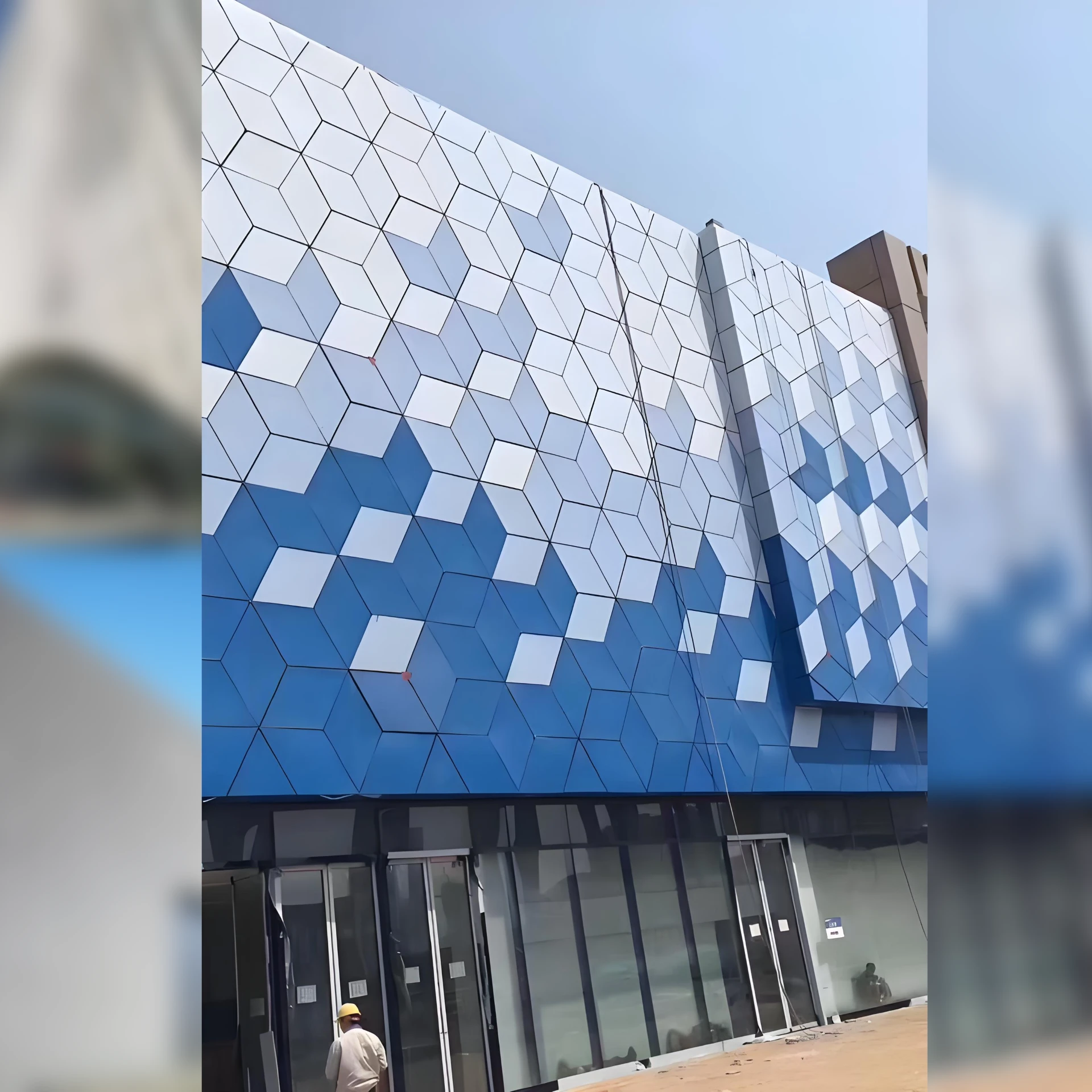
The flexibility of the Eco-Friendly E1 PVDF series allows for a wide range of architectural expressions. Because the panels are easy to bend, route, and fold, they are ideal for creating 3D geometric facades and complex curved surfaces. This design flexibility allows architects to move away from flat walls toward more dynamic, sculptural building envelopes.
Common application scenarios include:
- Commercial Exteriors: High-impact aluminum facade cladding for corporate headquarters.
- Interior Fit-outs: Safe, E1-grade ACP interior wall panels for sustainable office design.
- Specialized Signage: Durable, weather-resistant aluminum composite panel signage for retail brands.
- Modular Systems: Custom ACP modular panel systems for rapid deployment in prefabricated construction.
Whether it is a small-scale project of 100m² or a massive engineering undertaking of 100,000m², the material's adaptability ensures a seamless fit across diverse structural requirements.
Technical Specifications and Performance Matrix
| Parameter | Standard Specification | Performance Grade | Compliance Standard |
|---|---|---|---|
| Thickness | 3mm, 4mm, 6mm | High Structural Stability | China ACP Standard |
| Surface Coating | PVDF / PE | UV Resistant / Glossy | International Coating Std |
| Core Material | PE / Fire Rated | B1 & A2 Grades | SGS / Intertek Certified |
| Environmental | E1 Grade | Formaldehyde ≤ 1.5mg/L | ROHS / REACH |
| Max Length | Up to 6000mm | Customizable | OEM/ODM Capability |
Manufacturing Excellence and Quality Control Protocols
Reliability in cladding starts at the raw material stage. Our 30,000m² facility employs a strict six-step production process to eliminate defects. This begins with rigorous inspection of aluminum coils and PE particles, followed by a professional cleaning treatment to remove surface oils and oxidation, ensuring the PVDF coating adheres perfectly to the metal.
Precision is maintained through a fully automatic production line capable of producing 500,000m² per month. High temperature and pressure during the lamination process ensure a permanent bond between the aluminum skin and the core. To prevent warping, we strictly control the cooling rate, ensuring that every panel maintains absolute flatness, which is critical for the aesthetic quality of curtain wall installations.
Final cutting is performed according to exact customer specifications, followed by professional packaging designed to prevent scratches during international transit, ensuring the product arrives at the site in pristine condition.
Procurement Strategy for Large-Scale Cladding Projects
When procuring aluminum composite panels, buyers should focus on the total cost of ownership rather than just the per-square-meter rate. A lower aluminium cladding price often correlates with thinner aluminum skins or inferior core materials that may fail fire safety tests or warp under thermal expansion. Investing in CE-certified ACM compliance ensures that the project avoids legal complications and costly retrofits.
For large-scale engineering, we recommend a comprehensive solution approach. This includes collaborating with the manufacturer on material selection and fabrication early in the design phase. By utilizing direct factory wholesale services, developers can secure consistent quality and technical support, including 24-hour assistance for on-site installation and quality control.
Future trends in the industry are moving toward "Zero-Emission" building materials. By choosing E1-grade, non-toxic panels now, project owners are future-proofing their assets against stricter environmental regulations and increasing the resale value of sustainable commercial real estate.
Frequently Asked Questions About Aluminium Composite Cladding
What makes the E1 grade significant for interior cladding?
The E1 grade refers to a strict environmental standard where formaldehyde emissions are limited to ≤ 1.5mg/L. This ensures that the panels are non-toxic and safe for use in enclosed spaces, preventing "Sick Building Syndrome" and meeting health regulations for public buildings.
How does PVDF coating differ from PE coating in terms of application?
PVDF coating is designed for exterior use due to its high resistance to UV rays and weather, typically offering 20+ years of durability. PE coating is generally used for interior applications or short-term signage as it is more prone to fading when exposed to direct sunlight.
Can these panels meet strict fire safety codes for high-rise buildings?
Yes, we provide A2 and B1 fire-retardant grade panels. These are certified by SGS and INTERTEK, ensuring they meet international fire safety standards for commercial structures and curtain wall engineering.
What is the maximum custom length available for ACM sheets?
While our standard dimensions are 1220mm x 2440mm, we can provide custom lengths up to 6000mm to reduce the number of joints in large-scale facade projects, providing a cleaner architectural finish.
Do you provide technical support for on-site installation?
Yes, we provide complete engineering solutions including design, material selection, and on-site management services such as supervision, scheduling, and quality control, with 24-hour technical support available.
Which international certificates do your products hold for export?
Our products hold CE certification, ISO9001, ROHS, and REACH, along with general certifications for the EU, Australia, the United States, and Canada, facilitating smooth entry into global markets.
Technical References and Industry Standards
- ISO 9001 Quality Management Systems
- EU REACH Regulation on Chemical Safety
- ROHS Compliance for Hazardous Substances
- Intertek Fire Testing Standards
For architects and developers seeking a synergy of safety and aesthetics, our PVDF aluminum composite panels offer a proven solution. Contact our engineering team to discuss your project specifications and request a detailed quote based on your volume requirements.
Industry Insights and Application Guides